Precision Throw Challenge
Review
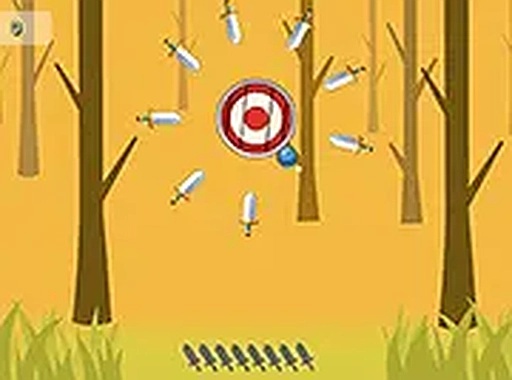
Precision Throw Challenge keeps its scope tight: throw items at a rotating target, avoid embedded objects, and survive as speed and density increase. The one-button control scheme makes it accessible, while special items add a risk-reward decision that prevents the loop from feeling purely mechanical. Short browser sessions and no download requirement make it easy to pick up. The main limitation is depth; there is no story or progression system described, so enjoyment depends on whether you like chasing timing-based scores.
About This Game
What You Actually Do
Precision Throw Challenge is built around one repeated action: throw an item at a rotating target. The target spins continuously, and your job is to land each throw in an empty space. If you hit an item that is already embedded, the throw fails. That single rule creates the tension. You are not aiming at a stationary board; you are reading a moving surface and committing at the right moment. The game uses tap or click controls, so there is no complex input to learn. The challenge comes from timing, not from memorizing buttons.
How Difficulty Escalates
Early throws feel manageable because the target has plenty of open space. As you progress, two things change at once. The target spins faster, and more items occupy the surface. Those changes compound: a faster rotation gives you less time to judge an opening, while a denser target shrinks the safe landing zones. The game also includes special items in some versions. These can award bonus points, but mishandling them may end your turn. That risk-reward layer means you cannot simply throw at the first gap you see; you have to decide whether a high-value item is worth the chance of losing your run.
Session Design and Accessibility
Runs are short by design, which makes Precision Throw Challenge easy to fit into a break. Because it runs in a browser with no download, you can start playing immediately on desktop or mobile. The visuals are clean and the gameplay is smooth, with no violent themes, so it suits players of all ages. The trade-off is that the game rewards patience more than speed. Rushing throws usually leads to collisions, especially once the rotation accelerates. Players who enjoy skill-based arcade challenges will get the most from it, while those looking for story or progression systems will find the scope limited to score chasing and timing mastery.




💬 Comments
0 comments