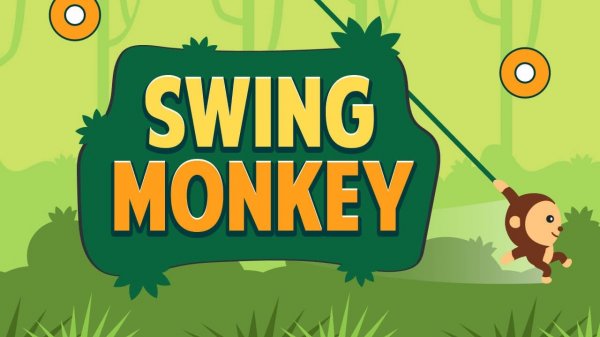
Canopy Swing Challenge
Review
Canopy Swing Challenge succeeds by narrowing its scope: one input, one decision, repeated across increasingly demanding layouts. The early stages teach the timing window without pressure, and later stages tighten gaps and add obstacles that reward planning ahead. The clean visuals and identical desktop and mobile controls lower the barrier to entry. The main limitation is that the entire experience rests on a single mechanic, so players who want variety may find it repetitive.
About This Game
One Motion, Many Outcomes
Canopy Swing Challenge reduces its entire control scheme to a single decision: how long to hold before letting go. Attach to a swing point, wait the right amount of time, then release. Hold too long and the character sails past the intended target. Release too early and the arc ends short. That narrow input window is where all the challenge lives, and it is why the game works equally well for a first-time player and someone chasing a cleaner run.
Swing Point Layouts and Obstacles
Each stage strings together a series of swing points across the environment. The arrangement of those points defines the route, so reading the layout before committing to a release matters as much as the release itself. Obstacles sit between points and punish sloppy timing. Early stages keep the spacing forgiving and the obstacle count low, which lets players internalize the rhythm of hold-and-release. Later stages tighten the gaps and add more obstacles, forcing players to plan two or three swings ahead rather than reacting one at a time.
Visual Clarity and Cross-Platform Controls
The cheerful, clean art style serves a mechanical purpose. Bright colors and uncluttered backgrounds keep the swing points and obstacles easy to track, while smooth animations give the character a playful bounce that makes each arc readable. Backgrounds shift subtly between stages without pulling attention from the action. On desktop, a mouse button handles the hold and release. On a touchscreen, the same action maps to a tap-and-hold. That parity means the game plays the same whether you are at a desk or on a phone during a short break.
How the Difficulty Curve Works
Progression is gradual by design. The opening stages function as a tutorial, letting muscle memory for the timing window develop before any real pressure appears. As stages advance, tighter gaps and denser obstacle placement test the skills built earlier. Each new stage layers onto the previous one instead of introducing a separate mechanic, so improvement feels continuous rather than reset. Players who enjoy rhythm-based precision and short, repeatable attempts will get the most out of it.





💬 Comments
0 comments